Table of Contents
You probably purchased a basic DSLR or mirrorless camera that came with a kit lens, usually something like an 18-55mm zoom. And as a beginner photographer, you might ask yourself if that is the perfect lense to start your photography journey.
While kit lenses are good for learning the basics, you’ll want to eventually use a lens that provides better results and lets you be more creative. And this is where prime lenses is the topic of this article.
Unlike zooms, there are fixed focal lenses like 14 mm, 35 mm, 50 mm, etc. That means you can’t rely on turning a zoom ring to frame your shots to get the desired picture, you must physically step closer or further away from the subject.
What does the mm mean?
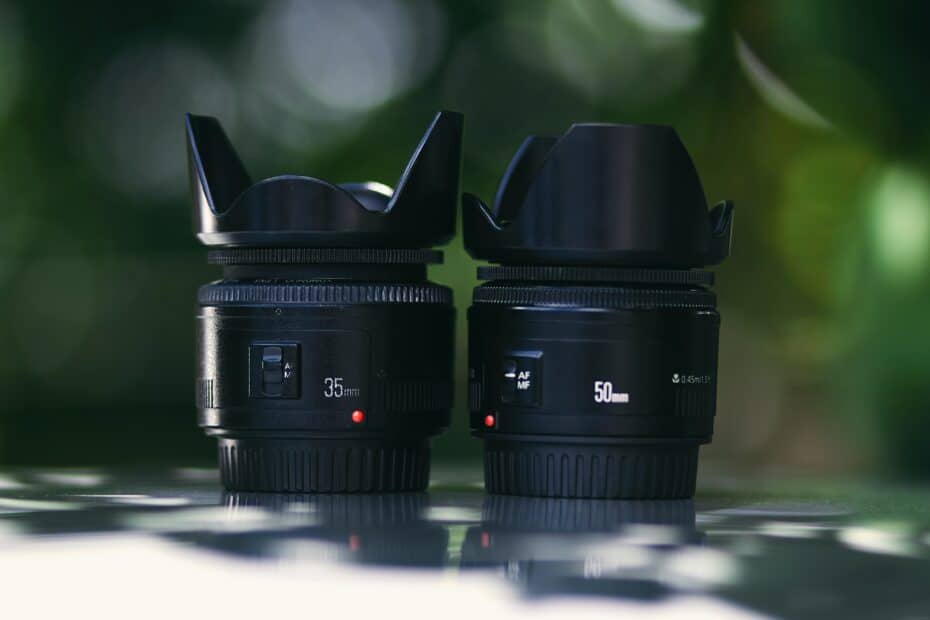
The 35mm and 50mm refer to the focal length of the lens.
Technically speaking, the lens’ focal length is the distance between the lens and the image it creates when centered at infinity.
… or, in more useful real-world terms, focal lengths decide whether we can fit more or less in the picture. In other words, how the image you see in the viewfinder looks “zoomed in” or “zoomed out.”
Longer focal lengths look more zoomed in (i.e. your subject takes up more of the frame) and shorter focal lengths appear less zoomed in (i.e. your subject appears smaller in the frame).
Here’s a useful thumb rule: if you have a full frame camera, the 50 mm focal length will give you a field of view similar to the naked eye. (Not true, but close enough to give you an idea!)
On the other hand, the 35 mm allows you to fit more into the picture, that is, everything will look a little more zoomed out, and you’ll see more of the world on either side of the subject.
What is a 50mm lens good for?
50 mm lenses are quick, maximum aperture lenses. Typically the standard 50 mm lenses are F1. 8 – Broad aperture. This means they’re perfect for low-light photography (e.g. , low-light portrait or indoor shooting) as they allow more light into the sensor of the camera.
What is a 35mm lens good for?
Like the 50 mm lens cousin, a 35 mm lens is known for excellent versatility. Using it on a full-frame camera to get a regular landscape view. … Using a 35 mm lens for street photography, design , product photography, and macro photography as well.
Is it worth having a 35mm and 50mm prime?
So, if you go from 50 mm to 35 mm, you’re gaining around 50% more in the picture. If you use APS-C or FX format, the 35 mm lens on it will give you the same viewing angle as 50 mm on a full frame, and 50 mm on APS-C or FX will give you the same viewing angle as 75 mm on a full frame.
Let’s take a deeper look at the advantages of both of these lenses.
What are the advantages of a 35mm or 50mm Lens?

Maybe the best advantage of prime lenses like 35 mm or 50 mm is they give much clearer images than most zoom lenses.
That’s because a zoom lens doesn’t have all the elements and moving parts inside it. With fewer “obstacles,” the result is often sharper photos.
Additionally, prime lenses have much wider apertures, which means they can gather much more light than their counterparts.
For example, a standard 18-55 mm kit lens may have an aperture range of f/3.5-f/5.6 while a 35 mm or 50 mm prime may have a constant aperture of f/1.8 or f/2 (or, for the lens above, f/1.4).
With all that extra light, you can take pictures with much more confidence (and better results!). This large aperture also helps blur the picture background, which is useful for portraits.
Another distinct advantage of prime lenses is that they appear to be smaller and lighter.
With a smaller lens, you have a better opportunity to work lean and mean, which is perfect for stuff like street photography or travel photography where having a large zoom lens on your camera will make it hard to find your way through crowds or take pictures without attracting everyone’s attention.
Also worth noting, many prime lenses are very inexpensive as lenses go. For eg, a brand new 50 mm f/1.8 lens for well under $150.
Another thing to realize is that prime lenses are incredibly flexible. That includes 35 mm lenses and 50 mm lenses.
For still photos or video, portraits or landscapes, day or night photography, you can use them!
And while 35 mm lenses and 50 mm lenses share all these things, you should be aware of some distinct differences.
35mm vs 50mm Lenses
When choosing between a 35 mm vs. 50 mm lens, one factor to remember is the field of view.
What is the difference between 35mm and 50mm?

Naturally, a 35 mm lens provides a wider view of the subject, which can make it a little more flexible. This is especially true of situations where you shoot in tight spaces or close quarters-the extra property from left to right captured by a 35 mm lens makes tight shots much easier to get.
The 35 mm focal length is also very realistic. For day-to-day photography, it’s a perfect walkaround lens-you can photograph varied subjects all day without having to swap your lens.
If you were to take a break for a few weeks and could only take one lens, a 35 mm would be a perfect option.

On the other hand, the 50 mm lens provides a narrower viewing angle that makes the pictures appear “zoomed in,” as you can see by contrasting Matterhorn pictures above.
While this could be perceived by some as a drawback, it can also be considered a positive-by providing a narrower field of view, you can extract foreign elements in the shot and highlight your intended subject more easily.
Besides enjoying your compositions, this extra focal length helps you to take good shots of more distant objects, which is not as easy to do with the wider 35 mm prime lens.
Moreover, if you took the same picture from the same location using the same camera settings with a 35 mm lens and a 50 mm lens, the 50 mm lens would give you a shallower field depth and better bokeh. That’s a major plus taking lots of portraits.

Perhaps the main difference in the 35 mm vs. 50 mm debate is price.
In this head-to-head match, 35 mm lenses cost far more. For eg, where you can find a Nikon 50 mm f/1.4 lens for about $450 brand new, a Nikon 35 mm f/1.4 lens runs about $900. Where you can get around, however, is buying pre-owned lenses.
For example, the Nikon-fit Sigma 35 mm f/1.4 DG HSM ART lens shown above. It’s a fantastic lens well-known for its excellent performance. Brand fresh, you can get one for about $650.
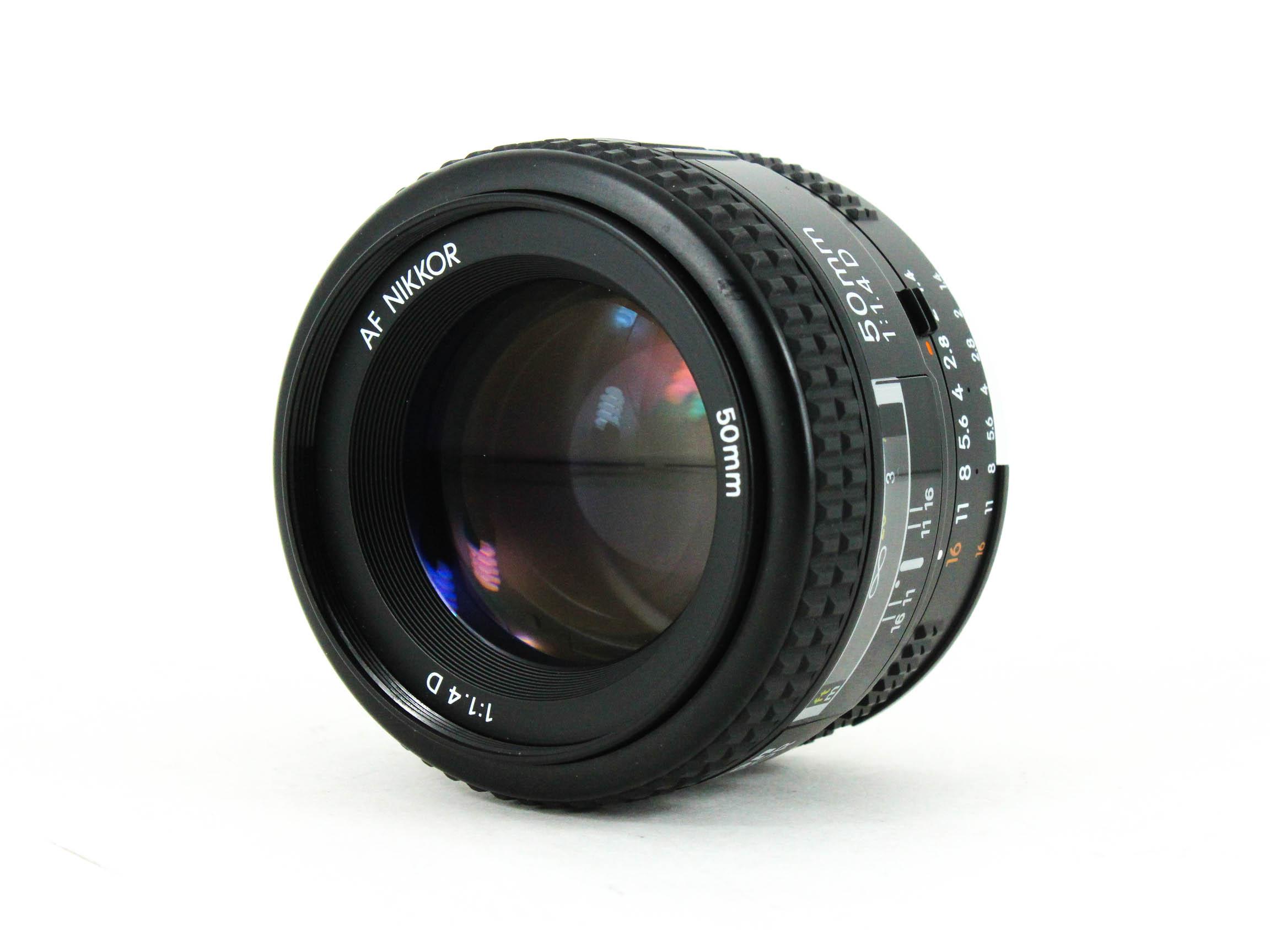
Another example is a used Nikon AF 50 mm f/1.4D as shown above for around $370 brand new.
The argument here is that you don’t just need to determine which focal length-35 mm or 50 mm-is better for you, but you also need to understand your budget and how purchasing used lenses will help you extend your budget.
And this isn’t all Nikon shooters’ chance either. There are plenty of great offers for Canon 35 mm f/1.4 lenses and 50 mm f/1.4 lenses.
Why are 50mm lenses so cheap?
It’s also around the shortest focal length where all good powers gather, so its components are minimal compared to longer focal lenses. (Note that there’s a reason why even 50 mm gets much more costly than f/1.8.)
Why is 35mm so expensive?
The reason the 35 mm lens is more expensive is due to the SLR’s flange-to-sensor size. To fit between lens mount and film or sensor, the SLR requires a mirror box. When it comes to wide-angle lenses, mirrorless bodies have a major advantage, lens construction can be simpler and smaller.
Here are some examples of when you would use a 35mm on a full frame camera:

- Shooting indoors and include some of the environment/scenes.
- Shooting outdoors and I wanted to include, for example, shooting at the beach, or hiking a mountain, or even at the park.
- Street photography.
- Group, events or family photography, where the focus is not just one person
- When you want to remain super close to my subject
Here are some examples when I would NOT use a 35mm for:
- Individual portrait close ups photography.
- When you’re looking for a good background blur because of lens compression. When a longer length lens is better.
Here is when I would use 55mm lens:

- Outdoors when shooting portrait style images and mix of environmental
- Indoors with enough space to back up in the room.
- Indoor portraits photography.
- Remain relatively close to to my subject
- Useful for all-purpose walk around / street lens
- If I wanted to take only ONE lens that was a good all-rounder.
When would I NOT use the 50mm?
- If you wanted more of the environment when wide angle is better
- If you are in a tight space, bathroom or small bedroom, etc.
- When you want lots of background blur
- For strictly portrait style photos
Is 35mm or 50mm better for portraits?
35 mm records more scene and matches full-length and waist portraits. 50 mm take shoulder-long pictures with no distortion and distinctly creamy bokeh. You can also use a 50 mm lens to catch more scene, but move back.
So, what is the verdict? 35mm or 50mm Lenses?
Here’s the bottom line…
While these lenses deliver excellent sharpness, low-light performance and flexibility, the flexibility front winner is the 35 mm lens.
If you want something to put on your camera and leave it on for days, it’s the 35 mm lens.
Also, if you want the chance to catch more of the scene in a single shot and have more of the background in focus, the 35 mm is the way to go.
However, if you want greater focal length distance, a 50 mm lens will suit you better.
These lenses are also smaller and lighter weight, making them perfect travel companions.
If portraiture is high on your list, the 50 mm provides a shallower field depth and better bokeh than a 35 mm, all else being equal.
And, of course, the high price of many 35 mm lenses makes 50 mm lenses an enticing choice, but you will find great offers on pre-owned 35 mm and 50 mm lenses if you know where to look.